Orion Financial
Website Redesign
Overview
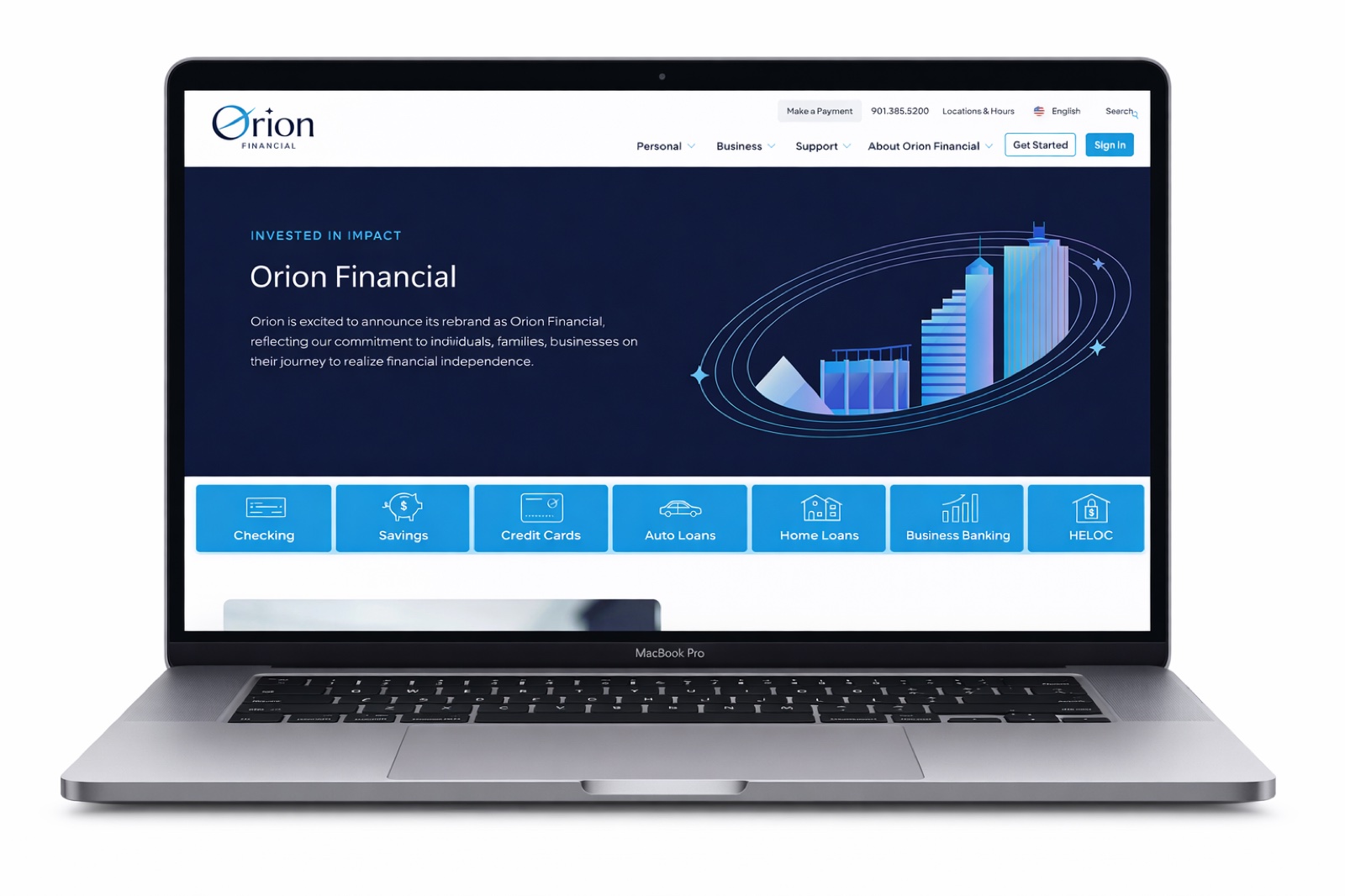
Orion Financial needed a redesigned website that reflected its evolution into an innovative, user-focused financial partner. The goal was to create a digital experience that felt intuitive, modern, and interactive — while maintaining the trustworthiness expected from a financial institution.
As Lead Designer and Project Manager, I guided the UX/UI strategy, design process, and cross-functional collaboration.
The Problem
The previous website suffered from:
- An outdated design with text-heavy pages and minimal interactivity
- Confusing navigation, making it difficult to distinguish between Personal and Business services
- Low discoverability of key products
- A lack of engagement — the experience felt formal, static, and uninspiring
Before the Experience
A walkthrough of the original Orion Financial site before the redesign.
Goals
Build a clean, intuitive layout with a clear content hierarchy
Use modern UI patterns and micro-interactions to reflect a forward-thinking brand
Create distinct pathways for Personal and Business banking
Design for both English and Spanish accessibility
Develop a more dynamic and visually rich user experience
Incorporate playful copy and approachable visuals (in collaboration with the ad agency) without compromising trust
Process
1. Discovery & Research
- Conducted stakeholder interviews
- Gathered and analyzed user feedback and pain points
- Performed competitive analysis across modern banking and fintech websites
- Researched CMS options and plugins, evaluating cost and budget constraints
2. Information Architecture
- Created sitemaps to reorganize content into two clear categories: Personal and Business
- Tested navigation prototypes with users to validate discoverability
3. Wireframing & Layout
- Developed low-fidelity wireframes to map key task flows
- Prioritized modular content blocks with bold CTAs
- Designed layouts to improve scannability
4. Visual Design & Interactivity
- Introduced modern UI patterns such as card layouts, hover states, responsive grids, and micro-interactions
- Applied a refreshed color palette and incorporated playful microcopy
5. Accessibility & Testing
- Ensured WCAG 2.0 compliance (contrast ratios, alt text, keyboard navigation)
- Conducted usability testing sessions using interactive prototypes
Key Design Choices
The redesign emphasizes:
Clarity over complexity
Primary segmentation like "Personal / Business / Loans" instead of generic labels, shallow navigation where users reach "Open Account" in 1–2 clicks, mega-menu showing all options at once without extra page loads.
Trust-first banking UX
Reusable UI like consistent product cards and "Open Account" buttons across pages, transparent info like visible APY/loan rates instead of hidden details, familiar layouts that match standard banking patterns so users feel safe.
Conversion-driven layout
Accounts prioritized with strong "Open Account" CTAs on homepage, loans surfaced with clear "Apply Now" paths for high-intent users, join CTAs repeated across pages to reduce friction to membership.
Challenges
• A 9-month timeline from initial discussions to launch
• Balancing a fun, innovative design with the credibility required in financial services
• Ensuring interactivity enhanced — rather than hindered — usability
• Aligning playful copy with clear, accurate financial product information
Outcomes
Streamlined navigation and modular layouts reduced user confusion
Interactive elements modernized the overall digital experience
Clear separation between Personal and Business improved product discoverability
Approachable visuals and conversational tone encouraged deeper engagement
Orion now feels modern, innovative, and user-friendly
Impact
- Re-architected navigation, user flows, and information architecture — significantly improving usability, discoverability, and conversion pathways
- Scaled platform performance with record-breaking engagement and session growth post-launch
- Translated business and user needs into clear UX documentation, user stories, and acceptance criteria — enabling efficient Agile delivery